Hurricane garage doors in Florida: how to read the label, what the code requires, and what the state pays
The garage door is the largest opening on the house and the one most likely to fail in a storm, and when it fails it takes the roof with it. This guide covers what a rating is, how to check yours, what Marion County requires on a new door, and how the My Safe Florida Home grant and insurance credits can pay for a lot of it.
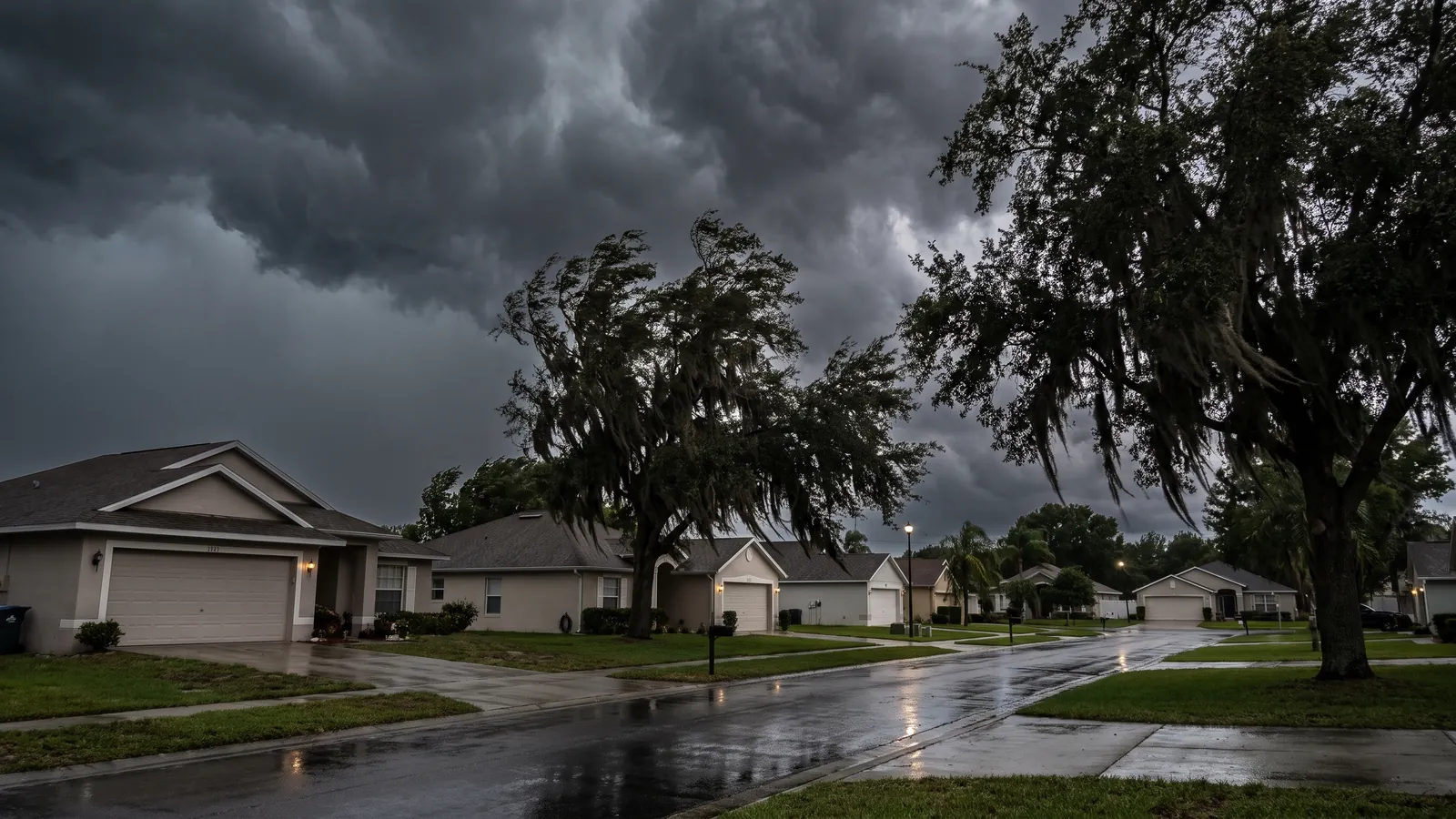
Why the door decides the roof
A house in a hurricane is a box. Wind pushes on the windward wall and sucks on the roof and the leeward side; as long as the box stays closed, the pressures roughly balance and the structure holds. Open the biggest hole in the box, a sixteen-foot garage door pushed in or pulled out, and the inside of the house pressurizes: now the wind is pushing up on the roof deck and out on the walls from inside while it's lifting the roof from outside. The Insurance Institute for Business and Home Safety calls the garage door a damage amplifier. In its field studies after Hurricane Ike and the Joplin and Moore tornadoes, garage door failure was consistently the start of structural damage elsewhere, and 90 percent of homes whose garage door survived had no structural roof damage. Its wind-chamber tests above 100 mph found the same thing.
What a rating is
A wind-rated garage door is tested to a design pressure: a positive number for the push and a negative number for the pull, in pounds per square foot, under ANSI/DASMA 108 or ASTM E330 (and TAS 202 in South Florida's high-velocity zone). The door is tested to 1.5 times that pressure. In Florida the door also carries a Florida Product Approval number, the state's record that the tested door is the door being sold. An impact-rated door goes further and is tested under ASTM E1996 against a 2-by-4 fired at it, so that flying debris can't breach it; that's required in windborne-debris regions near the coast and optional here.
What your opening needs
The design pressure a new door must meet depends on four things: the ultimate design wind speed for your address under the Florida Building Code, the door's size, the exposure category (B for a treed subdivision, C for open pasture or a new subdivision without trees, D on open water), and the mean roof height. DASMA's wind-load guide for the 2023 Florida Building Code tabulates it; as a feel for the numbers, a 9-by-7 door at 150 mph is about +21/−24 psf before the exposure factor, and Exposure C at a 15-foot roof multiplies that by 1.21. The permit reviewer confirms the number for your address; the door we install meets or exceeds it, with the heavier steel, horizontal struts, 14-gauge hinges, jamb brackets into solid framing and roller count the rating calls for.
How to check your current door
Go into the garage, close the door, and look on the inside of the door: the end stile, the back of a section, or near the bottom bracket. A rated door has a permanent label with the positive and negative design pressures and the test standard, and often the Florida approval number. No label almost certainly means no rating. IBHS found 80 to 90 percent of doors away from the coast aren't properly labeled, and the 2021 International Residential Code only recently required permanent labels. A door installed before 2006 in Marion County was very likely never rated; a door from a builder in the 2010s probably was, at the minimum the permit then required.
Bracing an existing door
Manufacturer reinforcement kits add horizontal struts and jamb brackets to an existing door, and some makers publish the pressure a braced door meets. They work on a sound, dent-free steel door whose maker allows it, they add weight the springs must be re-tensioned for, and they don't put a label on an unlabeled door for insurance purposes. A rusted, dented or wood door isn't a candidate. For most doors here that were never rated, replacement is the honest answer.
What My Safe Florida Home pays
Under section 215.5586 of the Florida Statutes, the program's hurricane mitigation grants cover "opening protection, including exterior doors, garage doors, windows, and skylights." The state pays $2 for every $1 the homeowner spends, up to $10,000; low-income homeowners can receive up to $10,000 with no match. The home must be a site-built, owner-occupied single-family home or townhouse with a homestead exemption, an insured value of $700,000 or less, an original building permit applied for before January 1, 2008, and a program wind mitigation inspection within the last 24 months. Townhouses are limited to opening protection. You can choose which openings to upgrade as long as they're on the inspection report, and the program may require all openings be protected as a condition of reimbursement. Funding depends on each year's appropriation, and applications open and close; check mysafeflhome.com for the current status. We provide the label photo, the approval number and the permit copy the claim requires.
What insurers credit
A wind mitigation inspection (Form OIR-B1-1802) scores opening protection, and a garage door with a documented rating counts toward it; some carriers credit a rated door on its own, most credit it alongside protected windows and doors. The discount depends on the carrier and the rest of the house. Ask your agent which rating level (A1, A2, A3 on the MSFH inspection) earns a discount before choosing the door.
Before the storm
Close the door and lock it; an open or partly open door is the worst case. If your opener has a manual slide lock, use it; if it doesn't, disconnect the opener and lock the door with its own lock if it has one. Move the car in or out before the power goes. Don't park against the door. And if the door won't close two days out, that's the call we move to the front of the line.
Common questions
Is Ocala far enough inland to skip this?
Marion County isn't the coast, but Milton cut power to nearly 47,000 customers here with its eye 110 miles away, and the building code requires every new garage door in the county to meet a design pressure. The question is only whether your old door ever did.
Wind-rated or impact-rated?
Wind-rated meets the pressure the permit requires and is what most Marion County homes install. Impact-rated also resists flying debris, is required near the coast, and costs roughly double. Here it's a choice for the most protection.
Does a braced door count for insurance?
A reinforcement kit strengthens the door but doesn't give an unlabeled door a label, and most inspectors score the label. A new rated door does both.
Can I get the grant for a garage door alone?
The program lets you pick which openings on the inspection report to upgrade, but it may require all openings be protected as a condition of reimbursement, and the rules change with each year's funding. Check the current program guidance before relying on it.
How do I find my design wind speed?
The permit reviewer sets it from the Florida Building Code map for your address; DASMA's wind-load guide tabulates the pressures by door size and speed. We confirm it on every permit and specify the door to it.
What about the golf-cart door?
It's a garage door opening too, and a new one is rated the same way. It's smaller, so the pressure is similar but the door is lighter and cheaper.
Related: Hurricane-rated doors · New garage doors · New door cost · Permits